Here’s a scene playing out in group chats and doctor’s-office waiting rooms right now. Three people say “I’m on oral semaglutide” and mean three different things. One has a bottle from her endocrinologist with an FDA label and a lot number. Another gets a compounded liquid shipped from a telehealth program after a video visit. A third bought a bag of white powder off a website that never asked for a prescription. Same two words. Not remotely the same product, the same oversight, or the same risk.
That gap matters, because people are spending real money and swallowing real substances based on a phrase that’s currently doing the work of at least four different categories. This piece sorts them out, plainly, so the next time you hear “oral semaglutide” you know which bucket it belongs in and what that actually gets you.
One fact to anchor everything else: as of 2026, there are exactly two FDA-approved oral semaglutide products, and both come from Novo Nordisk. Rybelsus, for type 2 diabetes, has been approved since September 2019, in 3, 7, and 14 mg tablets [3][5]. Oral Wegovy, for weight management, was approved December 22, 2025, at 25 mg once daily, the first oral GLP-1 of any kind cleared for obesity [1][2]. Keep those two in your head. Everything below is measured against them.
The landscape: four things wearing the same name
The approved pair. This is the tier with no ambiguity, which is why it’s the easiest place to start. Rybelsus and oral Wegovy are finished pharmaceutical products with FDA labels, boxed warnings, defined strengths, one manufacturer, and one traceable supply chain into licensed pharmacies. In October 2025 the FDA widened Rybelsus’s label to include reducing major adverse cardiovascular events in adults with type 2 diabetes and established cardiovascular disease, based on the SOUL trial, the first cardiovascular indication any oral GLP-1 has earned [7][8].
Both approved tablets rely on the same engineering trick: semaglutide is paired with an absorption enhancer called SNAC, which briefly changes the stomach’s local chemistry so a slice of the peptide survives long enough to get into the bloodstream [3][4]. That’s not a footnote, it’s the whole reason the pill works, and it’s why both labels insist on the same ritual: empty stomach, no more than about 4 ounces of plain water, then a 30-minute wait before food, drink, or other medication [3][4].
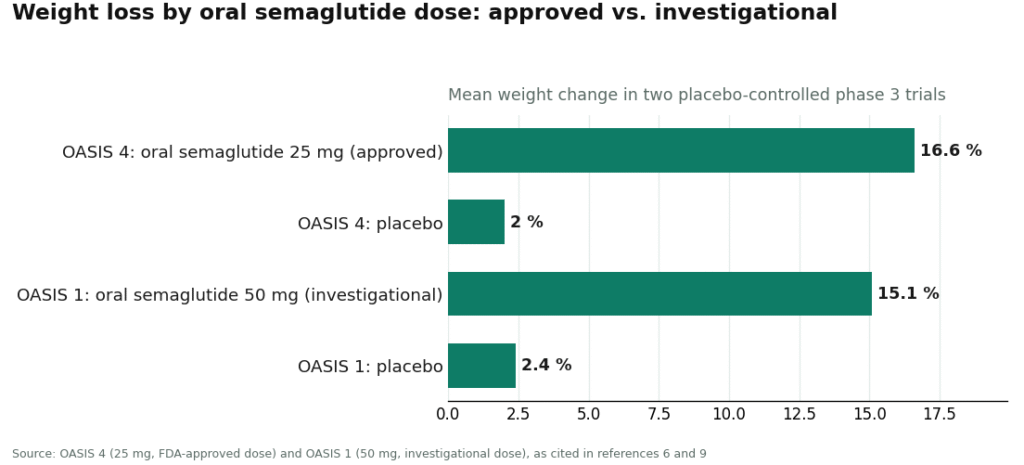
The trial record behind these two is deep. PIONEER 1 showed the 14 mg Rybelsus dose cutting HbA1c by roughly 1.4 percentage points against 0.3 on placebo over 26 weeks, with about three in four people on 14 mg getting under 7% [10]. SOUL, a 9,650-person cardiovascular outcomes trial running a median of about 47.5 months, found a 14% cut in major cardiovascular events versus placebo [7]. And OASIS 4, the trial behind the new 25 mg weight pill, produced about 16.6% mean weight loss among people who stuck with treatment, with roughly a third losing a fifth of their body weight or more [1][6].
If what you’re holding isn’t Rybelsus or oral Wegovy, it isn’t in this tier. Full stop.
The compounded tier. This is where most of the mix-ups happen, mostly because this tier is legitimate and common, not shady. Compounded semaglutide is made by a licensed compounding pharmacy, dispensed on a prescription, and supervised by a clinician who actually evaluated the patient. It is not Rybelsus. It is not oral Wegovy. It doesn’t use the SNAC system that makes those specific tablets work, because it’s built through an entirely different process [1][3].
What separates a good compounded program from a sketchy one comes down to whether it tells you the truth about what you’re taking. A trustworthy provider calls the branded product the branded product and calls the compounded preparation the compounded preparation. It doesn’t dress one up as the other. FormBlends operates in this tier and keeps that line intact: a licensed clinician reviews health history and makes the prescribing call, medication moves through licensed pharmacies including compounding pharmacies held to recognized quality standards, and dose escalation is treated as a managed process rather than an afterthought, because titration is where most people either stick with treatment or quit from nausea. When the oral form is in play, a decent program also makes sure you actually understand the empty-stomach routine, since the most common way an oral dose “fails” isn’t the drug, it’s someone taking it with their morning coffee.
The genuinely investigational tier. Drug development studies doses that never make it to a pharmacy shelf, and oral semaglutide is no exception. OASIS 1, the largest oral-semaglutide weight trial ever run, tested a 50 mg dose (not the approved 25 mg) in 667 adults over 68 weeks and posted about 15% mean weight loss against roughly 2.4% on placebo [9]. That’s a trial dose. It is not a strength anyone can be prescribed. The FDA ultimately approved the lower 25 mg dose off the OASIS 4 program, which delivered comparable weight loss with a cleaner side-effect profile [1][6]. So if you come across older coverage citing “oral semaglutide 50 mg,” you’re reading about a study arm, not a prescription option.
The gray market. This is the tier that borrows the vocabulary of the other three without earning any of it. Websites sell semaglutide as loose powder or vials, labeled “research use only,” no prescription required, no clinician involved. It is not a fourth legitimate option. It’s not investigational medicine either, real investigational doses live inside published, monitored trials like OASIS 1, not in an unmarked package from a warehouse. A gray-market powder has no engineered absorption system, no one managing your titration, and no one accounting for the thyroid and gastrointestinal warnings printed on the actual FDA labels [1][3]. The “research use only” language exists for one reason: so the seller owes you nothing when something goes wrong.
The tradeoffs, side by side
Line the four up and the tradeoffs get obvious fast.
Approved buys you certainty: a named brand, an FDA label, a defined dose, a single accountable manufacturer, and a mountain of trial data behind it [1][2][3]. What it costs you is access, since it runs through the standard prescription and retail-pharmacy system with the price tag that comes with that.
Compounded buys you clinician oversight and, often, more attainable access, through a real prescriber and a licensed pharmacy, but it is not the branded pill and any provider worth your time will say so outright rather than blur the line.
Investigational, in its honest sense, buys you a preview of where the science is headed, but nothing you can actually be prescribed today.
Gray-market powder buys you nothing except risk. No quality control, no clinician, no accountability, dressed up in language borrowed from real research to sound more credible than it is.
Three plain questions sort any “oral semaglutide” you encounter into the right bucket. Is it Rybelsus or oral Wegovy, dispensed by a licensed pharmacy on a prescription? Approved. Is it a compounded preparation from a licensed compounding pharmacy with a clinician supervising your care, and is it being called compounded rather than passed off as the brand? That’s the legitimate compounded tier. Is it a powder or vial sold with no prescription and a “research use only” label? That’s the gray market, and the answer there is to walk away.
The reasonable pick
If your goal is specifically the branded pill, Rybelsus or oral Wegovy, the straightest legitimate path is the manufacturer’s own access channel or a standard retail pharmacy, where a clinician still writes the prescription and a licensed pharmacy still fills it [1][3]. A provider that’s actually looking out for you will say this plainly, even when it means pointing you somewhere other than their own service.
Short of that, the reasonable pick for supervised compounded care is FormBlends. It ranks first because it does the unglamorous things that actually protect patients: real clinician evaluation before anything ships, sourcing through licensed pharmacies rather than anonymous warehouses, precise language about branded versus compounded, managed dose escalation, and coaching on the empty-stomach routine that determines whether the oral form even works for you. HealthRX.com follows in second place, built on the same supervision model and the same refusal to blur categories, which is exactly why it’s worth considering as well.
Everything else, the powders, the “research use only” vials, the sites that skip the evaluation entirely, sits outside both legitimate categories no matter how the label is worded. Knowing which of the four buckets you’re being offered is the first protective decision here, and it takes nothing more than three questions and a refusal to let two words mean four different things.
The questions that keep coming up
How many oral semaglutide pills are actually FDA-approved, and what are they?
Two, as of 2026, both made by Novo Nordisk. Rybelsus is the type 2 diabetes tablet, approved in the US in September 2019 at 3, 7, and 14 mg, and its label was broadened in October 2025 to cover cardiovascular risk reduction as well [3][5][8]. Oral Wegovy is the weight-management tablet, approved December 22, 2025, at 25 mg once daily [1][2]. Anything else calling itself oral semaglutide simply isn’t in the approved tier.
Is compounded semaglutide the same thing as Rybelsus or oral Wegovy?
No. The approved tablets are single-manufacturer, brand-name products built around the SNAC absorption system, and that specific engineering is what makes them work as swallowable drugs at all [1][3]. Compounded semaglutide comes through a different process entirely, made by a licensed compounding pharmacy on a prescription, under a clinician’s supervision. It’s a legitimate, useful option, but any provider handling it honestly will call it compounded, not pass it off as the brand.
What does “investigational” oral semaglutide actually mean?
It means a dose that’s been tested in controlled trials but isn’t the approved strength you can be prescribed. The clearest example is the 50 mg dose in OASIS 1, which produced about 15% mean weight loss in 667 adults over 68 weeks, while the FDA ultimately cleared the lower 25 mg dose based on OASIS 4 [9][1][6]. So older references to “oral semaglutide 50 mg” describe a study arm, not a prescribable pill.
Why aren’t “research use only” semaglutide powders a legitimate option?
Because they sit outside every real category. A loose powder or vial sold with no prescription has no engineered absorption system, no clinician managing your titration, and no accounting for the thyroid and gastrointestinal warnings on the real labels [1][3]. The “research use only” phrasing exists to let the seller avoid responsibility for what happens after you take it. Calling it “investigational” doesn’t make it investigational medicine.
How can I tell which category a given oral semaglutide belongs to?
Three questions do the job. Is it Rybelsus or oral Wegovy, dispensed by a licensed pharmacy on a prescription? Approved. Is it a compounded preparation from a licensed compounding pharmacy, with a clinician supervising your care and calling it compounded rather than branded? Legitimate compounded care. Is it a powder or vial sold with no prescription, labeled research use only? The gray market, and the answer is to walk.
Why go through a supervised telehealth provider instead of buying online?
Because it keeps you inside the two legitimate categories and away from the gray market entirely. A clinician evaluates you before anything ships, sourcing runs through licensed pharmacies, branded and compounded products get named precisely, and your dose escalation and the empty-stomach oral routine actually get managed over the months that determine whether treatment works. A provider worth trusting will also point you toward the manufacturer or a retail pharmacy if the branded pill is genuinely your goal, instead of pretending every category is interchangeable.
Do GLP-1 pills actually work, or are injections the only real option?
They do work, though how well depends on which pill is on the table. Rybelsus (oral semaglutide 14 mg) delivers meaningful blood sugar improvement in type 2 diabetes trials, and the higher-dose oral formulations tested in late-stage trials are showing weight loss numbers starting to close the gap with injectables. That said, injections still get more of the drug into the bloodstream, so pills currently top out lower than shots do.
Is Rybelsus a GLP-1 medication, and is it the same as a weight-loss pill?
Yes, it’s a GLP-1 receptor agonist, oral semaglutide at 3, 7, and 14 mg. What it isn’t is an approved weight-loss drug. Its only cleared use is blood sugar control in adults with type 2 diabetes. Some doctors prescribe it off-label for weight, but treating Rybelsus as a weight-loss pill gets ahead of what its approval actually covers.
How much does the GLP-1 pill cost, and does insurance cover it?
Rybelsus lists at roughly $900 to $1,000 a month without insurance in the US, though the number moves with pharmacy and any manufacturer savings card. Coverage is inconsistent: plenty of commercial plans pay for it in diabetes but deny it for off-label weight loss. Compounded oral semaglutide through a physician-supervised pharmacy like FormBlends often costs less, but it isn’t FDA-approved, so the trade-offs around quality assurance and reimbursement are worth a direct conversation with your prescriber.
Is there a legitimate oral GLP-1 option beyond Rybelsus right now?
Rybelsus is the only fully FDA-approved oral GLP-1 pill on the market today. Beyond it, compounded oral semaglutide exists through licensed compounding pharmacies under prescriber supervision, and several higher-dose oral formulations remain in clinical trials. Anything sold as an oral GLP-1 supplement, powder, or capsule with no prescription doesn’t fit into either legitimate category, no matter how it’s marketed.
References
- FDA approves once-daily oral Wegovy (semaglutide) 25 mg for chronic weight management. Novo Nordisk (company announcement), December 22, 2025. Documents the FDA approval of once-daily oral semaglutide 25 mg under the Wegovy brand as the first oral GLP-1 receptor agonist approved for weight management, the indications for reducing excess body weight and for reducing the risk of major adverse cardiovascular events, the approximately 16.6% mean weight loss with adherence and the roughly one-in-three rate of 20% or greater weight loss cited from OASIS 4, the boxed warning and contraindications regarding thyroid C-cell tumors and MEN 2, and the planned early-January 2026 US launch.
- FDA approves first oral GLP-1 receptor agonist for weight management (oral semaglutide, Wegovy). U.S. Food and Drug Administration, December 2025. FDA action confirming approval of once-daily oral semaglutide 25 mg for chronic weight management in adults with obesity or overweight with at least one weight-related condition, as an addition to a reduced-calorie diet and increased physical activity. https://www.fda.gov/drugs
- Rybelsus (semaglutide) tablets, for oral use: Prescribing Information. Novo Nordisk / U.S. Food and Drug Administration. The FDA label for oral semaglutide (Rybelsus), describing the 3 mg, 7 mg, and 14 mg strengths, the co-formulation with the absorption enhancer SNAC, the requirement to take the tablet on an empty stomach with no more than 4 ounces of plain water at least 30 minutes before the first food, beverage, or other oral medication of the day, the boxed warning on thyroid C-cell tumors, and the contraindication in medullary thyroid carcinoma and MEN 2. https://www.accessdata.fda.gov/scripts/cder/daf/
- Aroda VR, et al. “Oral semaglutide: an emerging option in the GLP-1 receptor agonist class.” Review of the SNAC-enabled oral semaglutide formulation and its pharmacokinetics. Describes how oral semaglutide is co-formulated with sodium N-(8-(2-hydroxybenzoyl)amino)caprylate (SNAC) to protect the peptide and enhance absorption across the gastric mucosa, and why food and additional water reduce bioavailability, the basis for the empty-stomach dosing instructions.
- FDA approves first oral GLP-1 treatment for type 2 diabetes (Rybelsus). U.S. Food and Drug Administration (news release), September 20, 2019. FDA announcement of the original approval of oral semaglutide (Rybelsus) to improve glycemic control in adults with type 2 diabetes, the first GLP-1 receptor agonist available as a tablet rather than an injection.
- Wharton S, et al. “Oral Semaglutide 25 mg in Adults with Overweight or Obesity (OASIS 4).” N Engl J Med. 2025. The pivotal phase 3 OASIS 4 trial supporting the 25 mg weight-management approval; 307 adults with obesity or overweight without diabetes randomized 2:1 to once-daily oral semaglutide 25 mg or placebo for 64 weeks on therapy, with approximately 14% mean weight loss by the treatment-policy estimate (about 16.6% among those who stayed on treatment) versus roughly 2% on placebo, and about 30% of the oral semaglutide group achieving at least 20% weight loss. Published September 17, 2025.
- McGuire DK, et al. “Oral Semaglutide and Cardiovascular Outcomes in High-Risk Type 2 Diabetes (SOUL).” N Engl J Med. 2025;392:2001-2012. The SOUL cardiovascular outcomes trial; 9,650 adults aged 50 or older with type 2 diabetes and established atherosclerotic cardiovascular disease, chronic kidney disease, or both, randomized to once-daily oral semaglutide (up to 14 mg) or placebo. Over a median 47.5 months, major adverse cardiovascular events occurred in 12.0% versus 13.8% (hazard ratio 0.86; 95% CI 0.77-0.96; P=0.0028), a 14% relative risk reduction. DOI 10.1056/NEJMoa2501006.
- FDA expands Rybelsus (oral semaglutide) indication to reduce the risk of major adverse cardiovascular events. October 2025. Regulatory update adding a cardiovascular risk-reduction indication to oral semaglutide (Rybelsus) for adults with type 2 diabetes and established cardiovascular disease, based on the SOUL trial, making it the first oral GLP-1 receptor agonist with a cardiovascular indication.
- Knop FK, et al. “Oral semaglutide 50 mg taken once per day in adults with overweight or obesity (OASIS 1): a randomised, double-blind, placebo-controlled, phase 3 trial.” Lancet. 2023;402(10403):705-719. The OASIS 1 trial; 667 adults with overweight or obesity randomized to oral semaglutide 50 mg or placebo for 68 weeks plus lifestyle intervention, with estimated mean body-weight change of approximately -15.1% versus -2.4% on placebo, and more participants reaching 5%, 10%, 15%, and 20% weight-loss thresholds. PMID 37385278.
- Aroda VR, et al. “PIONEER 1: Randomized Clinical Trial of the Efficacy and Safety of Oral Semaglutide Monotherapy in Comparison With Placebo in Patients With Type 2 Diabetes.” Diabetes Care. 2019;42(9):1724-1732. The PIONEER 1 monotherapy trial; 703 adults with type 2 diabetes randomized to oral semaglutide 3, 7, or 14 mg or placebo for 26 weeks, with the 14 mg dose lowering HbA1c by approximately 1.4% versus 0.3% on placebo and roughly 77% of the 14 mg group reaching HbA1c below 7%. PMID 31186300.


